

ENVIRONMENTAL IMPACT (ENVIRONMENTAL SUSTAINABILITY)
Total Scope 1 and 2 Carbon Emissions in tCO2e (tonnes (t) of carbon dioxide (CO2)
As educational institutions worldwide strive for sustainability, Universiti Teknologi Malaysia (UTM) has taken a decisive step in tracking and mitigating its environmental impact. A comprehensive deep dive into the 2025 carbon footprint of the Skudai Campus reveals a total gross emission output of 36,818.39 tonnes of carbon dioxide equivalent (tCO₂e). This figure represents the greenhouse gas emissions generated across all campus operations before accounting for natural carbon removal. When evaluated against the campus population of 15,931 students and staff, the per capita intensity stands at a benchmark of 2.31 tCO₂e per person.
Crucially, the Skudai Campus benefits significantly from its natural "Green Lung." Spanning 1,271 acres, the campus’s dedicated forest, palm oil, and rubber plantations act as a vital carbon sink, successfully sequestering 2,686.24 tCO₂e annually. Factoring in this natural offset, UTM's net emissions are reduced to 34,132.15 tCO₂e, highlighting the immense value of integrating natural landscapes into institutional infrastructure.
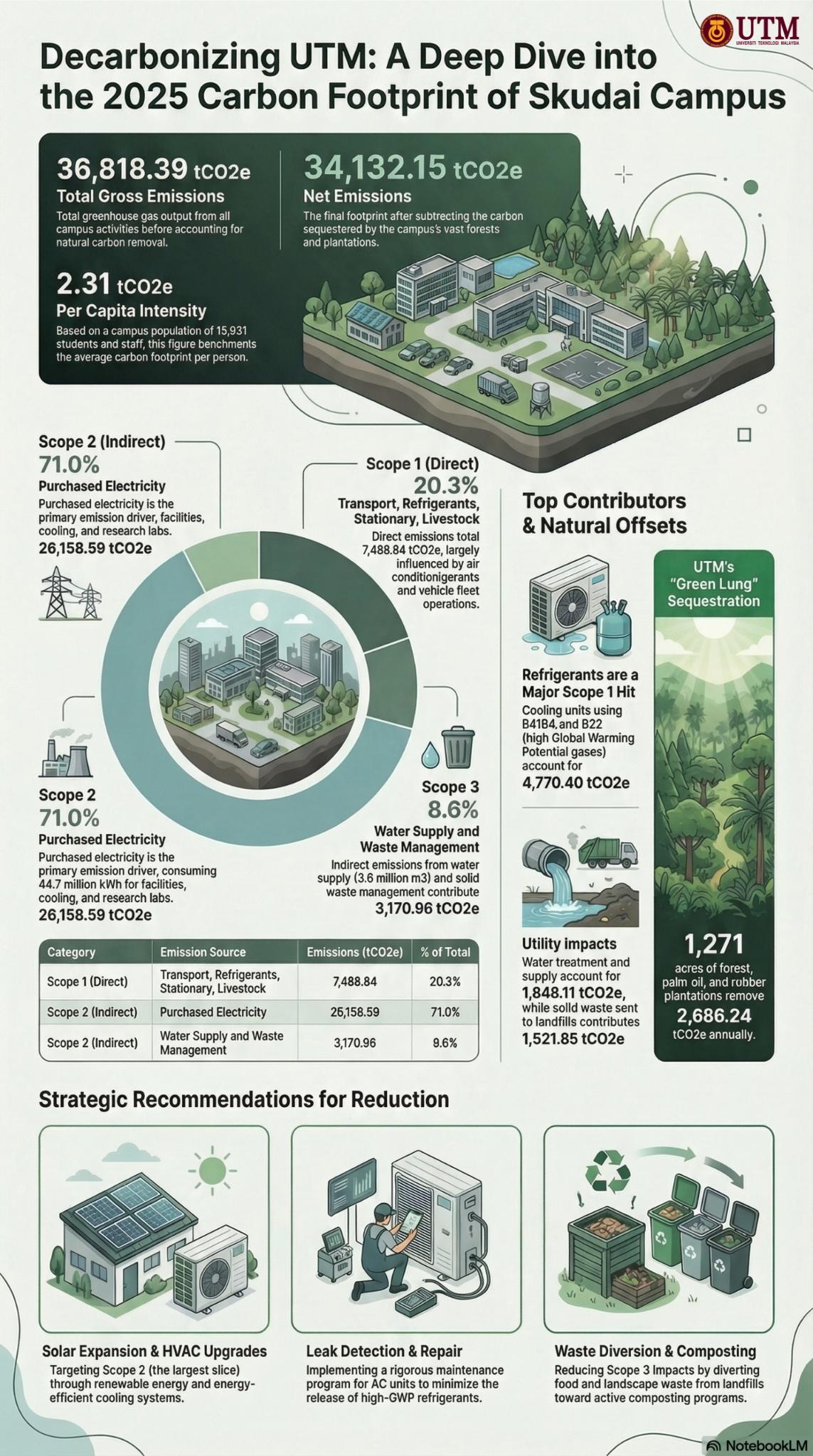
Detailed breakdown of UTM Skudai Campus carbon footprint, illustrating emission sources, key contributors, and strategic opportunities for decarbonisation and emissions reduction.
For the last full reporting year, UTM Skudai Campus reported total Scope 1 and Scope 2 carbon emissions of 33,647.43 tCO2e, comprising:
Scope 1 (Direct): 7,488.84 tCO2e
Scope 2 (Indirect – Purchased Electricity): 26,158.59 tCO2e
These figures are presented in UTM’s 2025 carbon footprint infographic, “Decarbonizing UTM: A Deep Dive into the 2025 Carbon Footprint of Skudai Campus.” The infographic identifies Scope 1 emissions as arising from transport, refrigerants, stationary sources, and livestock, while Scope 2 emissions are primarily from purchased electricity used for facilities, cooling, and research laboratories.
To effectively decarbonize, understanding the specific emission sources is critical. The campus footprint is divided into three primary scopes:
- Scope 1 (Direct Emissions – 20.3%): Generating 7,488.84 tCO₂e, direct emissions stem primarily from transport, vehicle fleet operations, stationary sources, and livestock. The most significant vulnerability within this scope lies in cooling technology. Refrigerants utilizing high Global Warming Potential (GWP) gases, specifically R410A and R22, account for a striking 4,770.40 tCO₂e, proving to be a major direct emission hit.
- Scope 2 (Indirect Emissions – 71.0%): Representing the overwhelming majority of the campus's carbon burden, purchased electricity contributes a massive 26,158.59 tCO₂e. Keeping a modern campus operational requires immense energy; the Skudai Campus consumed 44.7 million kWh to power its extensive facilities, energy-intensive research laboratories, and critical cooling infrastructure.
- Scope 3 (Indirect Emissions – 8.6%): Totaling 3,170.96 tCO₂e, this category encompasses broader utility impacts. The indirect emissions from the treatment and supply of 3.6 million cubic meters of water contribute 1,848.11 tCO₂e, while solid waste directed to local landfills adds another 1,521.85 tCO₂e to the overall footprint.
Armed with these specific data insights, UTM has outlined three strategic recommendations to aggressively reduce its climate impact moving forward:
- Solar Expansion & HVAC Upgrades: To tackle the dominant Scope 2 emissions (the largest slice of the footprint), the campus aims to scale its renewable energy infrastructure through expanded solar arrays and transition to highly energy-efficient cooling systems.
- Leak Detection & Repair: Addressing the severe Scope 1 refrigerant impact requires implementing a rigorous, preventative maintenance program for all air conditioning units to minimise the accidental release of harmful high-GWP gases.
- Waste Diversion & Composting: To lower Scope 3 emissions, UTM will actively divert food and landscape waste away from traditional landfills, redirecting these materials toward active, sustainable composting programs.
Through these targeted interventions, UTM is strategically positioning the campus as a model for effective, data-backed decarbonization.

